
By the GACS Team · Last updated October 2026
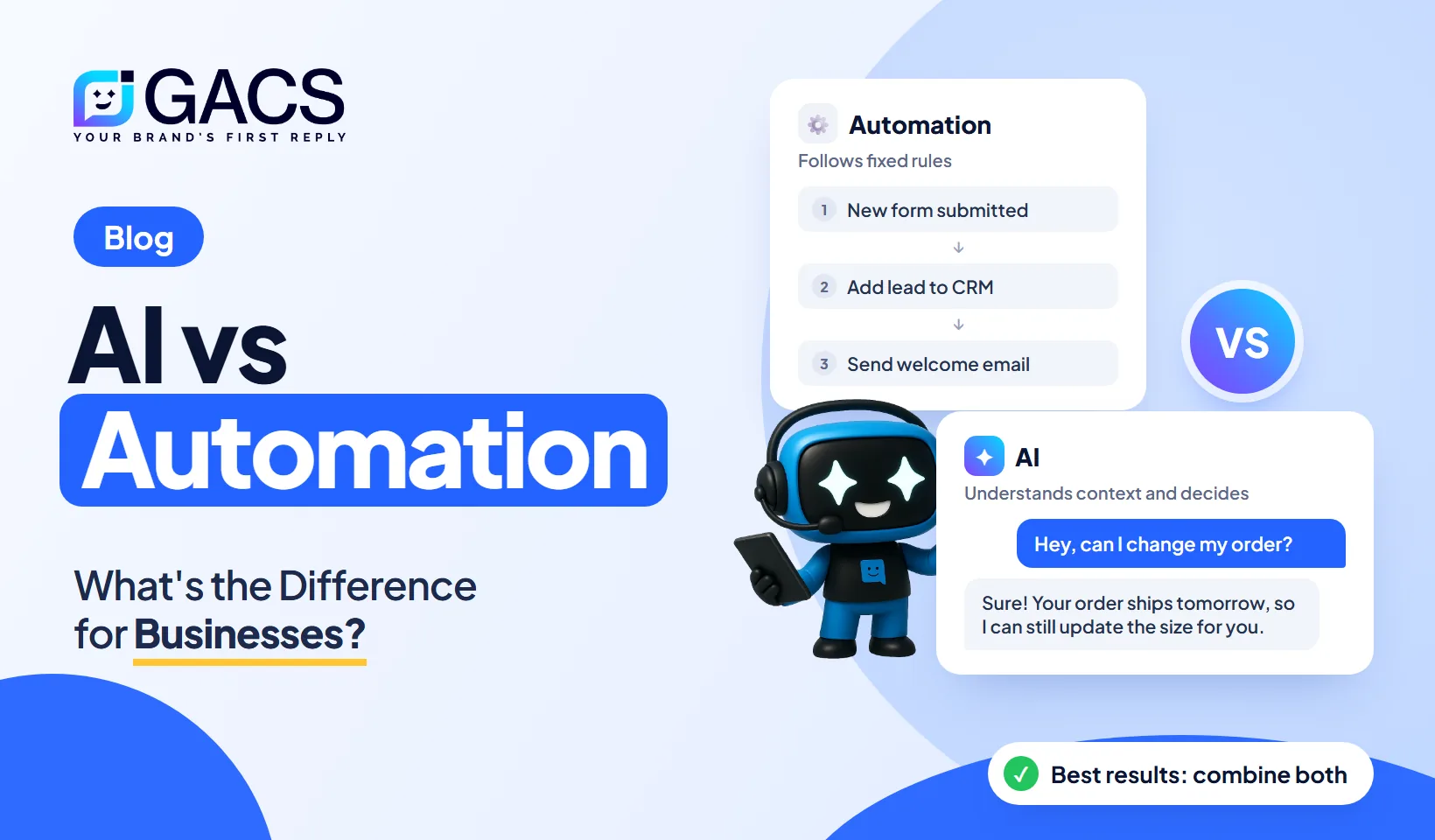
Quick answer: Automation follows fixed rules to complete repetitive tasks the same way every time. AI understands context, learns from data, and makes decisions when situations vary. Automation is best for predictable, structured work. AI is best for work that involves language, judgment, or exceptions. Most businesses get the best results by combining the two.
What Is Automation?
Automation is technology that completes a task by following rules you define in advance. If X happens, do Y. It never gets tired and never skips a step, but it only handles situations you planned for.
Common examples include sending a welcome email when someone signs up, copying form entries into a spreadsheet, or moving an invoice to "paid" once a payment clears. Process automation and robotic process automation (RPA) both fall into this category.
What Is AI?
Artificial intelligence is technology that can interpret information, recognize patterns, and make decisions without a fixed script. Modern AI understands natural language, so it can read an email, answer a customer question it has never seen before, or decide which lead looks most likely to buy.
The potential is large. According to McKinsey research, about 60 to 70 percent of the time people spend working could theoretically be transformed by generative AI combined with other technologies.
AI vs Automation: Key Differences
| Automation | AI | |
|---|---|---|
| How it works | Follows fixed rules | Understands context and decides |
| Best input | Structured data (forms, fields) | Unstructured data (text, chats, documents) |
| Handles exceptions | No, it stops or errors | Yes, within limits |
| Setup | Map every step in advance | Provide content, examples, and goals |
| Maintenance | Update rules when processes change | Update the content it learns from |
| Example | Send an invoice reminder on day 7 | Answer "Can I change my order?" in any wording |
In short, automation does what you tell it. AI figures out what to do.
What Is Intelligent Automation?
You don't have to choose one. IBM defines intelligent automation as combining AI, business process management, and robotic process automation to streamline and scale decision-making. AI handles the judgment, and automation handles the repeatable steps that follow.
When to Use Automation, AI, or Both
- Use automation when the task is repetitive, the inputs are structured, and the rules rarely change, such as data entry, scheduled reports, or status updates.
- Use AI when the task involves language, varied requests, or judgment, such as answering customer questions, reading documents, or qualifying leads.
- Use both when a process starts with something messy and ends with something predictable. AI understands the request, then automation completes the steps.
Real Business Examples
Customer Support
A rule-based system routes tickets by keyword. An AI agent reads the question, answers it from your help docs, and only escalates what it can't solve.
Lead Qualification
Automation adds every form submission to your CRM. AI chats with the visitor, asks about budget and timeline, and flags the serious buyers.
Ecommerce Orders
Automation sends shipping confirmations. AI answers "Where's my order?" and sizing questions in the customer's own words and language.
Invoice Processing
Automation files invoices and sends reminders. AI reads invoices in different formats and extracts the right fields.
Employee Onboarding
Automation creates accounts and sends checklists. AI answers new hires' policy questions around the clock.
AI vs Automation in Customer Service
Customer service shows the difference clearly. A rule-based chatbot follows a decision tree: it works until a customer asks something outside the script, then fails. An AI agent reads your documents, website, and product data, so it can answer new questions accurately and hand the rest to your team with full context.
The strongest setups combine both. AI handles the conversation, and customer service automation handles the follow-through: logging the lead in your CRM, sending the tracking link, or booking the callback.
How to Get Started
- List your repetitive tasks and mark which ones involve language or judgment.
- Automate the rule-based tasks first for quick wins.
- Add AI where requests vary, starting with your most common customer questions.
- Keep a human handoff for anything sensitive or uncertain.
- Track time saved, response speed, and conversion before expanding.
Frequently Asked Questions
What is the main difference between AI and automation?
Automation follows fixed rules to repeat tasks. AI understands context and makes decisions when situations vary.
Is AI the same as automation?
No. Automation executes predefined steps. AI interprets information and decides what to do. They often work together.
Can AI replace automation?
Not entirely. Rule-based automation is still faster, cheaper, and more predictable for structured tasks. AI adds value where judgment is needed.
What is intelligent automation?
Intelligent automation combines AI with process automation, so systems can both make decisions and complete the steps that follow.
Is a chatbot AI or automation?
It depends. A rule-based chatbot is automation. An AI chatbot uses language models to understand and answer open-ended questions.
Which is better for small businesses?
Start with simple automation for repetitive admin, then add AI for customer conversations, where it saves the most time.
Combine AI and Automation with GACS AI
GACS AI answers customers on your website, WhatsApp, and phone using your own content, in 50+ languages. It captures leads, sends them to your CRM automatically, and hands anything it shouldn't handle to your team. See how GACS AI works, and most businesses go live the same day.