

By the GACS Team · Published October 2026
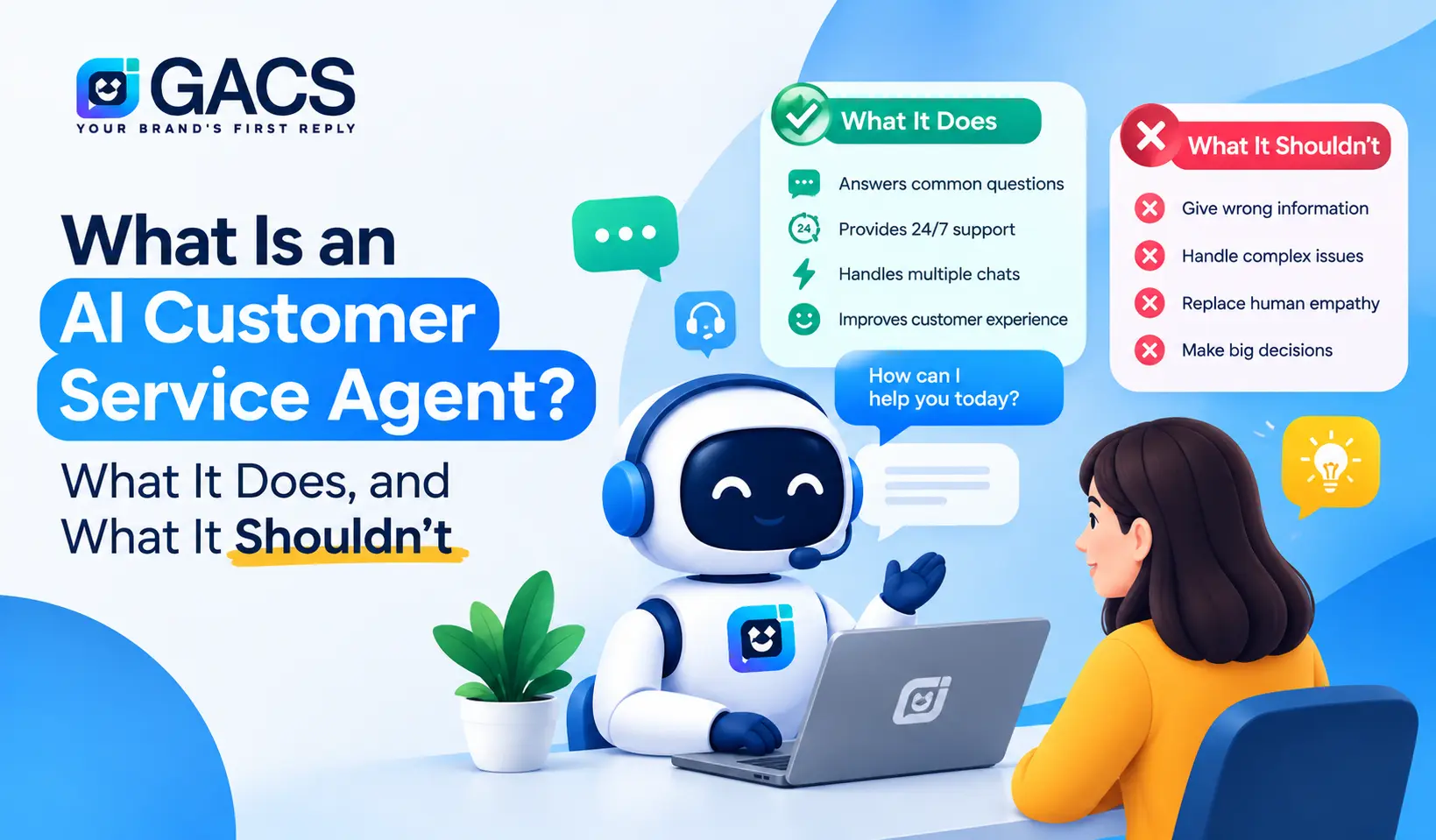
An AI customer service agent is software that answers customer questions and completes simple tasks on its own, in plain language, across channels like your website, WhatsApp and phone. Unlike older chatbots that follow fixed menus, it understands free-typed questions and can look up real information, like an order's status. A good one also knows when to stop and hand the customer to a person.
How an AI Agent Differs From an Old-Style Chatbot
| Rule-based chatbot | AI customer service agent | |
|---|---|---|
| How it understands customers | Buttons and keywords | Plain-language questions |
| Where answers come from | Scripted replies | Your policies, product info and order data |
| What it can do | Show fixed answers | Answer, look up information, complete simple tasks |
| When it's stuck | Loops or dead-ends | Hands over to a person with the history attached |
| Channels | Usually website only | Website, messaging apps and voice |
What an AI Customer Service Agent Can Handle Today
The best candidates are questions that are frequent, repetitive and answerable from information you already have:
- Order questions: "Where is my order?", delivery times, order changes
- Policy questions: shipping costs, return windows, warranties
- Product questions: sizing, compatibility, stock
- Account and booking basics: opening hours, appointments, simple account questions
Analysts expect this list to grow fast. Gartner predicts that by 2029, agentic AI will resolve 80% of common customer service issues without human intervention, cutting operational costs by 30%. That's a forecast, not today's reality, so judge any tool on what it does now.
What It Shouldn't Handle Alone
AI agents are weakest where judgment, emotion or exceptions come in:
- Complaints from angry customers
- Refund disputes and exceptions to policy
- Anything involving safety, legal or medical questions
- Situations your policies don't cover
Customers agree. In a Gartner survey of 3,566 customers in early 2026, 87% said companies using GenAI for customer service must provide access to a human agent. The same survey found the ability to switch to a person was the most common thing that would make customers more willing to use AI.
The right model isn't AI instead of people. It's AI for the repetitive questions, and people for the rest.
Why Businesses Are Moving Now
Customer service budgets are shifting toward AI. A Gartner survey of 199 service leaders in April and May 2026 found AI spending in customer service rose 38% while overall service budgets grew just 2%. Those leaders expect GenAI chatbots to become their most valuable service channel within two years, and GenAI voicebots their third.
How to Choose an AI Customer Service Agent
Five questions separate a useful agent from a risky one:
- Where do its answers come from? It should answer only from your content and data, and say when it doesn't know. An agent that fills gaps with general AI knowledge will eventually invent a policy.
- How does handoff work? Customers should reach a person in one step, with the conversation history passed along.
- Can it see order data? If order questions fill your inbox, an agent limited to your FAQ won't help much.
- Which channels does it cover from one setup? Separate bots for web, WhatsApp and phone mean separate answers to keep in sync.
- How is it priced? Per seat, per conversation or per resolution. For per-resolution pricing, ask exactly what counts as resolved.
A quick test for any demo: ask it something your content doesn't cover, like a discount code that doesn't exist. A good agent says it doesn't know and offers a person. A bad one makes something up.
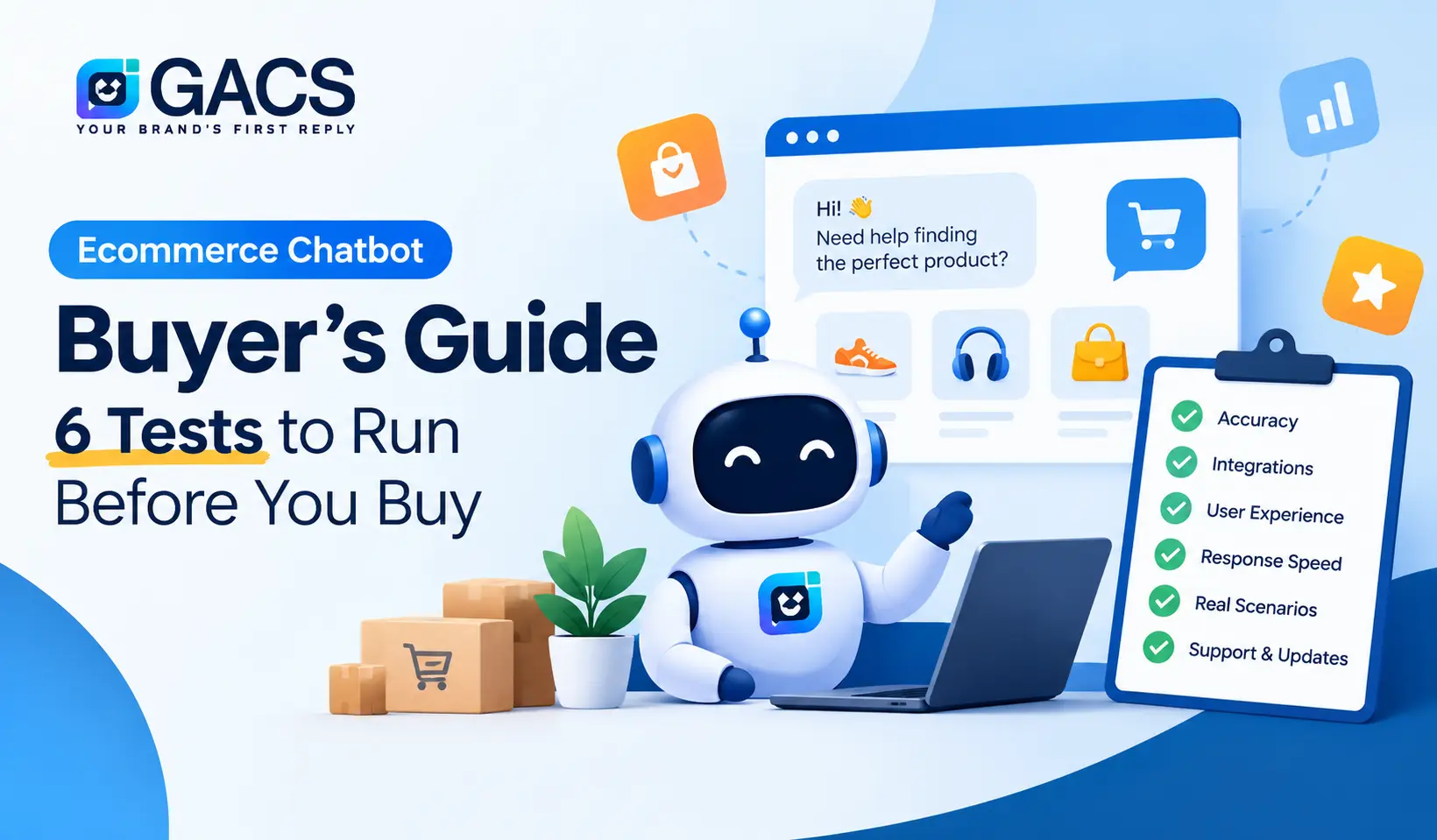
Running an online store? Our ecommerce chatbot buyer's guide covers six store-specific tests in more detail.
How to Roll One Out Without Annoying Customers
- Start with your top 10 questions. Pull them from your inbox and give the agent clear answers for each.
- Make the human option visible. Don't hide it behind three failed attempts.
- Read transcripts weekly for the first month. Fix wrong or weak answers at the source, in your content.
- Expand gradually. Add new question types and channels once the first set works well.
Where GACS Fits
GACS is an AI customer service agent for websites, WhatsApp and voice, running from one knowledge base in more than 50 languages. It answers pre-sale questions and order questions like "where is my order?", only from your content and data, and says when it doesn't have an answer instead of guessing. When a conversation needs a person, it hands over with the history attached. It goes on your website with a single script tag, and Shopify order tracking is live, so shoppers can ask where their order is and get the answer straight from Shopify.
See how it works for online stores on the GACS ecommerce page, or book a demo and run the five questions above on it yourself.
Frequently Asked Questions
Will AI customer service agents replace human agents?
Not for most businesses. They take over repetitive questions so people can focus on complex ones. Customers still expect a person to be available.
How long does it take to set one up?
It depends on how organized your content is. If your policies and product information are already written down, a basic agent can be live quickly. Most of the work is in reviewing answers during the first weeks.
Is an AI customer service agent the same as a chatbot?
It's a type of chatbot, but a more capable one. Older chatbots follow fixed scripts. AI agents understand plain language, look up information and complete simple tasks.
Book a free demo of GACS and run the five questions on it yourself