
Start with the boundary, because it decides whether the rest of this page is useful to you.
GACS AI does not give financial advice. It does not move money. It does not handle transactions. It does not make eligibility or credit decisions and it does not access accounts. Anything advisory, regulated or transactional goes to a member of your staff.
That limit is not a gap waiting to be filled in a later release. It is the design.
What is left is access. Fees, product features, documentation requirements, how a process works, what the published criteria are. That is most of the inbound volume at a bank, a lender or a broker, and none of the regulated risk.
Published rate cards and fee schedules, asked in a hundred different phrasings.
Documentation checklists, which are the most repeated question on any product line.
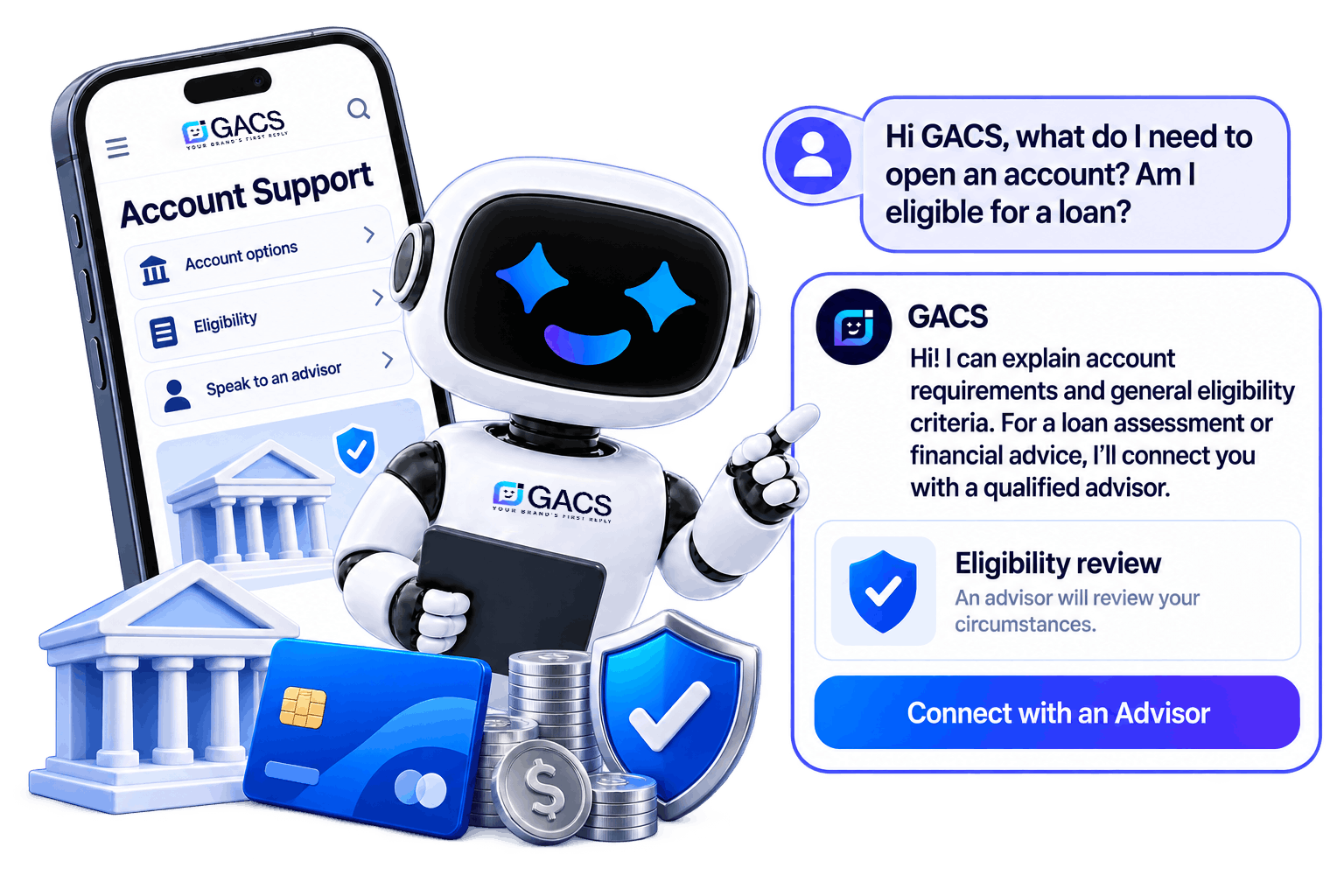
The one that matters most, and the one the agent handles by not answering it.
The agent states criteria. It never applies criteria to a person.
Answers are built from sources your firm controls. You import your website by URL, upload PDFs such as rate cards, terms and product summaries, write manual entries for procedures not published publicly, and connect a Google Drive folder or a Notion workspace that stays in sync as your compliance and product teams update it. When a rate changes, you change the source.
The agent answers from that material and nowhere else. Given a question outside it, it says so and offers a person rather than producing a plausible answer. That is the difference between an AI chatbot for banking you can put in front of customers and one your compliance team will ask you to take down.
It captures a name, an email and the stated reason for contact, so a conversation that has to reach a person arrives with context attached.
Zendesk CX Trends found that 70% of CX leaders say generative AI makes every digital customer interaction more efficient. In a regulated firm that efficiency has to come from the questions that were never regulated in the first place, and those are the majority of the volume.
This section is the one to bring to your compliance team.
Handoff carries the full transcript, so the customer does not repeat themselves and your agent sees exactly what was said. Human agents also get AI reply suggestions drawn from the same knowledge base, with the agent deciding what actually gets sent.
The website widget installs with one snippet. Email routing and answering use the same knowledge base, as do inbound and outbound phone calls. WhatsApp runs on your own business number through Meta's Cloud API signup flow, set up from the dashboard without a developer.
Staff and role management controls who handles which conversations. Usage analytics show what customers are asking, which is evidence for where published material is unclear.
Retention periods, audit logging and the regulatory position of any deployment depend on how the system is set up and on your jurisdiction. These should be agreed before contracting. If you need control over where data is stored, GACS AI can run on a private server in the country you choose, or on your own cloud account. Ask us about it on a demo.
GACS AI holds no financial services authorization and is not a regulated entity. It is software your firm operates within your own regulatory perimeter.
No. It describes published products. Any recommendation is advice and goes to your staff.
No. It does not connect to account systems and cannot see balances, transactions or application status.
No. It does not move money and does not handle transactions of any kind. It explains the published process and hands the conversation to a person.
It says it does not have that information and offers to pass the conversation to a person. It does not guess.
The most useful demo is one run against your own published material, with your compliance team in the room, so the boundary can be tested rather than described.
Also relevant: WhatsApp on your own number.