

By Montazir Abidy, Director of Strategic Accounts, Diggit Software Solutions · Updated September 2026
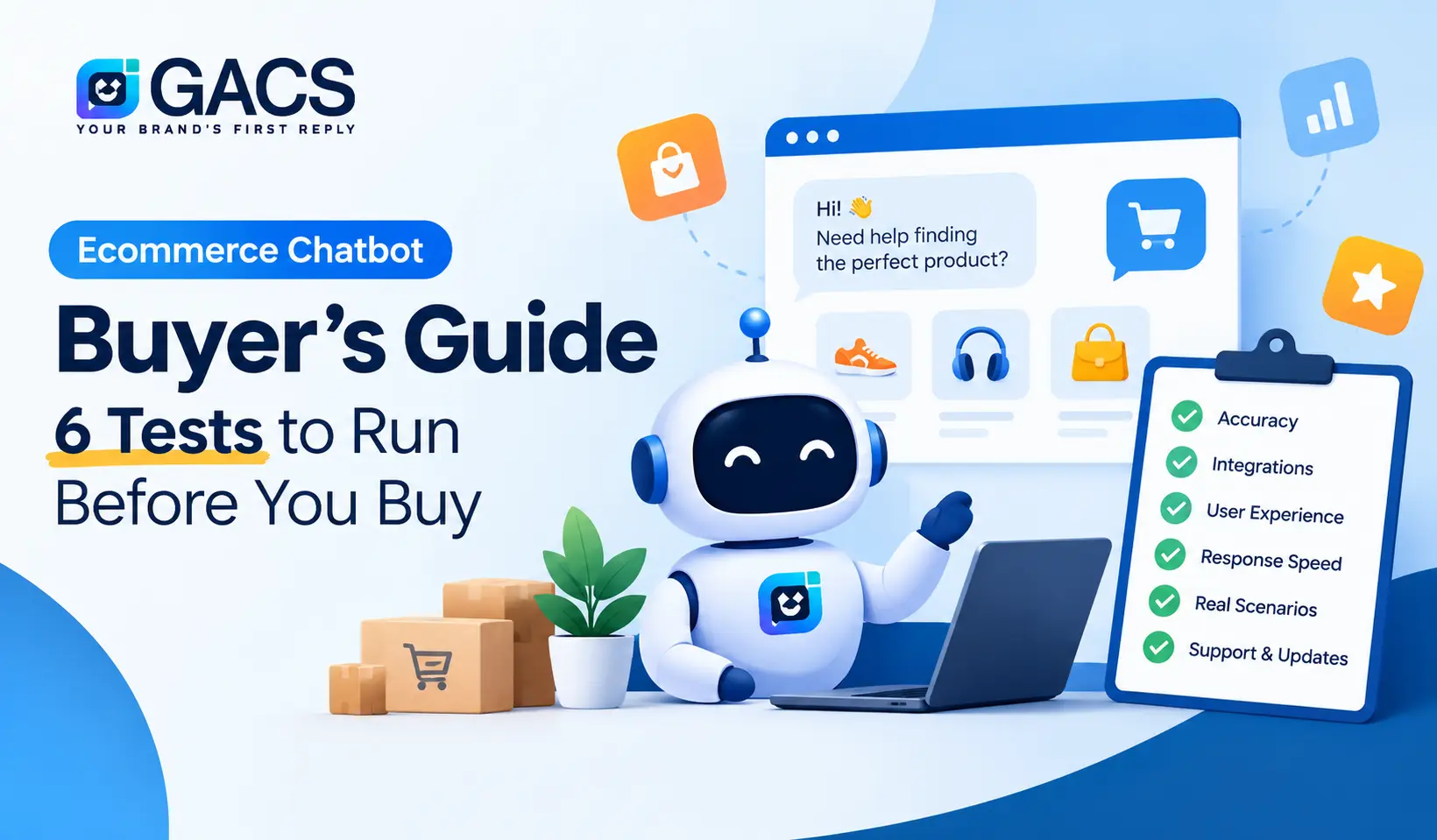
An ecommerce chatbot is software on your online store that answers shoppers' questions in real time: shipping costs, return rules, sizing, stock, and where an order is. The good ones answer only from your own store content and hand the shopper to a person when they can't help. Before you buy one, test it on six things: accuracy, human handoff, order data, channels, languages and pricing.
Most "best ecommerce chatbot" lists are published by chatbot companies, and each one puts its own product first. This guide gives you the tests instead, so you can judge any tool, including ours.
Why Stores Are Adding AI Chatbots Now
Two things changed in the past year.
First, shoppers are arriving from AI tools. Adobe reported that traffic to US retail sites from generative AI tools rose 693.4% in the 2025 holiday season compared with the year before. Those shoppers are used to asking a question and getting a direct answer.
Second, AI is already part of how people buy. Salesforce's data on 1.5 billion shoppers found AI and agents influenced $67 billion of the $336.6 billion spent globally during Cyber Week 2025, about 20% of all purchases.
Businesses are responding. In a Gartner survey of 199 service leaders in April and May 2026, AI spending in customer service rose 38% while overall service budgets grew 2%. The same leaders expect GenAI chatbots to become their most valuable service channel within two years.
Where a Chatbot Actually Helps a Store
The clearest case is the questions that stop a sale.
Baymard Institute puts the average cart abandonment rate at 70.22% across 50 studies. Among shoppers who abandon at checkout, 40% leave because extra costs like shipping and tax were too high, 20% because delivery was too slow and 13% because the returns policy was unsatisfactory.
A chatbot can't lower your shipping fee. It can answer "how much is shipping to Dallas?" or "can I return this if it doesn't fit?" at the moment the shopper is deciding, instead of leaving them to hunt through a policy page.
The other cases are the repetitive questions your team answers every day: order status, return steps, product details, stock and store hours.
Test 1: Does It Answer Only From Your Content?
A chatbot that makes up a return window or a discount creates refunds, disputes and angry reviews. Ask the vendor:
- Where does the bot get its answers? Your uploaded policies and catalog only, or general AI knowledge too?
- What happens when the answer isn't in your content? It should say it doesn't know and offer a person. It should never guess.
How to test it: ask the demo bot a question your store content doesn't cover, like a discount code that doesn't exist. Watch what it does.
Test 2: Can a Shopper Reach a Human in One Step?
This is the test customers care about most. In a Gartner survey of 3,566 customers in February and March 2026, 87% said companies using GenAI for customer service must provide access to a human agent. Gartner also warned that customers pushed through several failed AI attempts before reaching a person are less likely to use the tool again.
Ask the vendor:
- Can the shopper ask for a person at any point?
- Does the conversation history go to your team, so the shopper doesn't repeat themselves?
- What happens outside your working hours? The bot should take details and promise a follow-up, not loop.
Test 3: Can It See Order Data, or Only Your FAQ?
This is the biggest difference between tools, and vendor pages rarely make it clear.
- Knowledge-based bots answer from content you give them: policies, FAQs, product information. They are quick to set up and good for pre-sale questions.
- Order-connected bots also read your store's order system, so they can answer "where is my order?" with a real tracking status, or start a return.
If most of your support tickets are order status questions, you need an order-connected bot. If most are pre-sale questions about shipping, sizing and returns, a knowledge-based bot covers them.
Test 4: Does It Work Where Your Customers Message You?
List where your customers contact you today: your website, WhatsApp, Instagram, the phone. Then check which of those each tool covers from one setup.
Running one bot for web chat and another for WhatsApp means two sets of answers to keep up to date, and they will drift apart. Voice matters too. Gartner's service leaders expect GenAI voicebots to be their third most valuable channel within two years.
Test 5: Does It Handle the Languages Your Shoppers Use?
If you sell across borders, ask which languages the bot answers in, and whether it detects the shopper's language automatically or needs a separate setup for each one. Test it in each language you sell in, not just English.
Test 6: What Are You Actually Paying For?
Ecommerce chatbots are priced in very different ways:
- Per seat: you pay for each team member using the inbox.
- Per conversation: you pay for every chat the bot handles, whether or not it solved anything.
- Per resolution: you pay only when the bot resolves a conversation without a person.
Per resolution sounds safest. Ask exactly how the vendor defines a resolution. A shopper who gives up and leaves may count as one.
How Four Common Options Compare
Details below come from each vendor's own website, checked in September 2026. Features and prices change, so confirm with the vendor before you buy.
| Tool | Answers from | Channels | Pricing model | Best fit |
|---|---|---|---|---|
| Shopify Inbox | Your Shopify catalog, policies and store content | Your Shopify storefront | Free | Shopify stores wanting a basic AI sales associate at no cost |
| Tidio Lyro | Your knowledge base | Web chat, and can plug into other help desks | From $32.50/month for 50 AI conversations | Small stores starting with low chat volume |
| Gorgias AI Agent | Your brand content, policies and Shopify catalog | Help desk, voice, SMS | Paid per resolved conversation | Shopify stores already using Gorgias as their help desk |
| GACS | Your store content and order data only; says so when it doesn't know | Web chat, WhatsApp and voice from one knowledge base | From $149/month for 500 chats, plus a one-time $299 setup | Stores handling order and pre-sale questions across channels and languages |
Where GACS Fits, and Where It Doesn't
GACS answers shoppers on your website, WhatsApp and by voice from one knowledge base, in more than 50 languages. It handles both pre-sale questions and order questions like "where is my order?", so it passes Test 3 as an order-connected bot. It answers only from your store's content and data, and says when it doesn't have an answer, rather than guessing. When a conversation needs a person, it hands over with the history attached. It goes on your site with a single script tag, and Shopify order tracking is live, so shoppers can ask where their order is and get the answer straight from Shopify.
It's a strong fit if your customers reach you on more than one channel, you sell to shoppers in more than one language, or order-status questions fill your inbox.
You can see how it works for online stores on the GACS ecommerce page, or book a demo and run the six tests above on it yourself.
Frequently Asked Questions
What is an ecommerce chatbot?
Software on an online store that answers shopper questions automatically, such as shipping, returns, product details and order status. AI chatbots understand free-typed questions instead of following fixed menus.
Is an AI chatbot worth it for a small store?
It depends on how many repetitive questions your team answers. If the same ten questions take up hours each week, a knowledge-based bot is quick to set up and can take most of them. If you get a handful of messages a day, a free tool may be enough.
Will customers be annoyed by a chatbot?
They are annoyed by bots that block them from a person. 87% of customers in Gartner's 2026 survey said a human must be available. A bot with a clear, one-step handoff avoids most of that.
What's the difference between an ecommerce chatbot and an AI shopping assistant?
The terms overlap. "Shopping assistant" usually means pre-sale help, like finding products. "Chatbot" or "AI customer service agent" usually covers support too, like returns and order questions.
Sources
- Adobe, Holiday shopping season 2025 results, January 7, 2026
- Salesforce, Cyber Week 2025 data, December 5, 2025
- Gartner, AI spending by customer service leaders surged 38%, August 26, 2026
- Gartner, 87% of customers say GenAI service must provide access to a human, August 4, 2026
- Baymard Institute, Cart abandonment rate statistics, updated September 2025
- Vendor pages for Shopify Inbox, Tidio, Gorgias and GACS, accessed September 2026
Book a free demo of GACS and run the six tests on it yourself